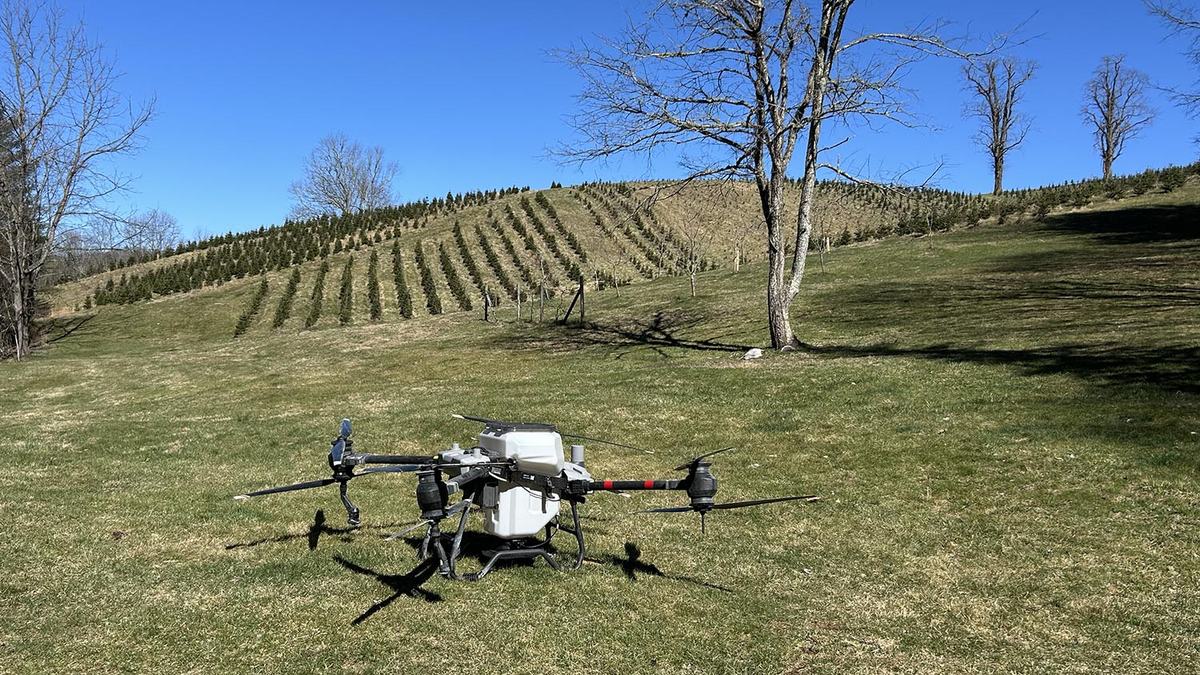
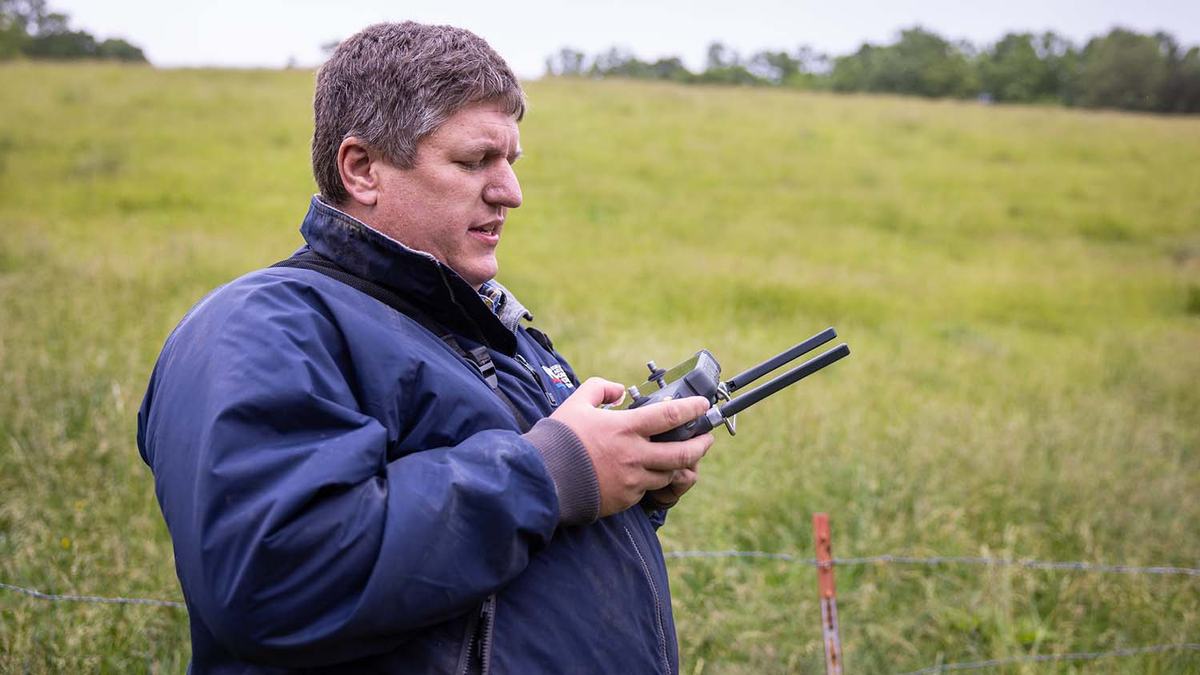
Around the state, he has another identity. He is Extension’s drone guy.
Nagy has used unmanned aerial vehicles (UAVs) for photography and mapping, and for spraying and seeding.
“They can be used in multiple segments of the agriculture industry,” Nagy said.
He gives demonstrations and provides training for other agents, encouraging them to adopt technology that can benefit farmers through precision planting and targeted weed and pest management.
“Seth is the one who got me into this,” said David Davis, director of Extension’s Yancey County Center, who used a drone to reseed hay fields and riverbanks ruined by Hurricane Helene. “He has helped a lot of agents get their license. He's been a tremendous help.”
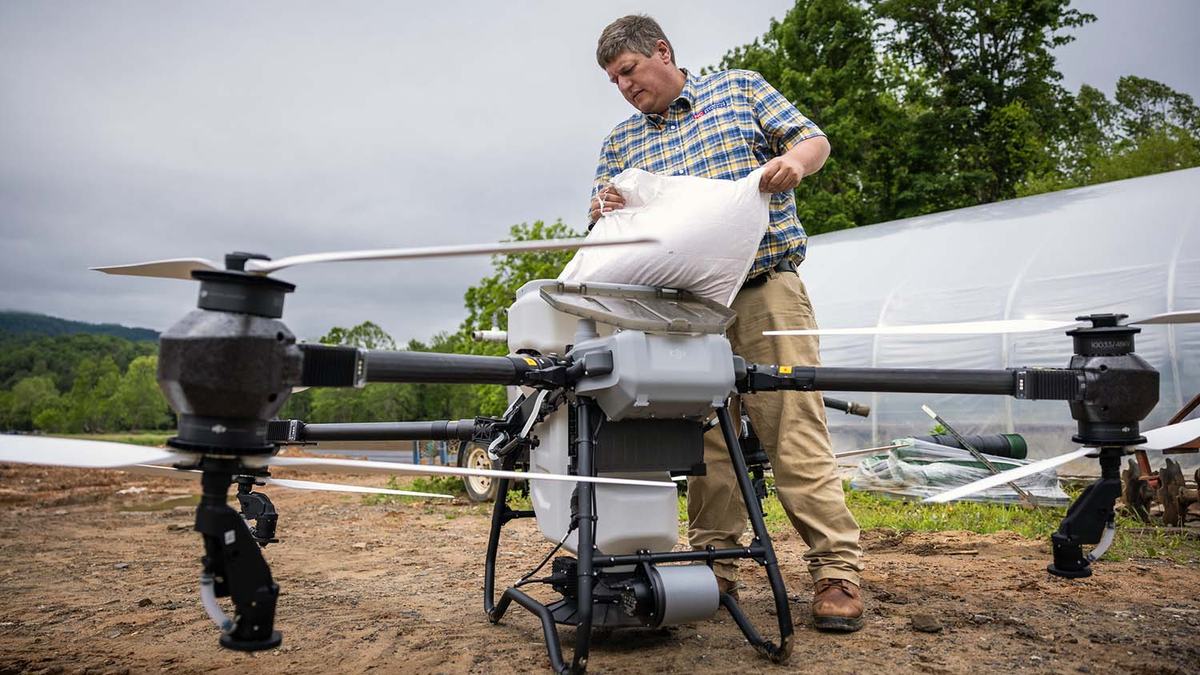
David Davis, director of Extension's Yancey County Center, loads grass seed into an agricultural drone. The grass became forage for livestock in fields damaged by Hurricane Helene.
It isn’t surprising that Nagy would be drawn to the flying machines and be at the forefront of innovative ways to adapt them to Extension work. He has lived much of his life with an eye toward the skies.
“When I was a kid I loved model airplanes, RC [remote control] airplanes, model rockets, all that stuff,” he said. “I built and flew 'em. I had a blast with it.”
He continued to build and tinker with them as an adult, even engineering cameras so he could take aerial photos.
He was able to incorporate his avocation into his vocation.
“I went across the state with [Extension stormwater expert] Bill Hunt and took aerial pictures of his water quality projects in 2002 or 2003, and did some other aerial photography work,” Nagy said.
GPS-enabled drones were becoming commercially available about the same time, but the remote control aircraft purist was not enticed by the new technology.
“I knew a little bit about drones,” he said. “The last thing I wanted to do is mess up my RC fun with computers and drones and having extra equipment.”
That changed in 2017, when Extension experts from Clemson and Arkansas conducted a UAV exhibition at a nursery plants field day. They showed the capabilities of drones for aerial imaging and mapping.
“They showed some demonstrations of what the drone can do,” Nagy said. “It was absolutely fascinating.”
The lure was immediate. Rather than mess up his RC fun, this would enhance it.
“With the RC airplanes, you were having to guess a little bit at what the camera was seeing,” he said. “With the drones, you could actually see what the camera saw. There was just so much cool stuff. It was absolutely incredible. I jumped in with both feet.”
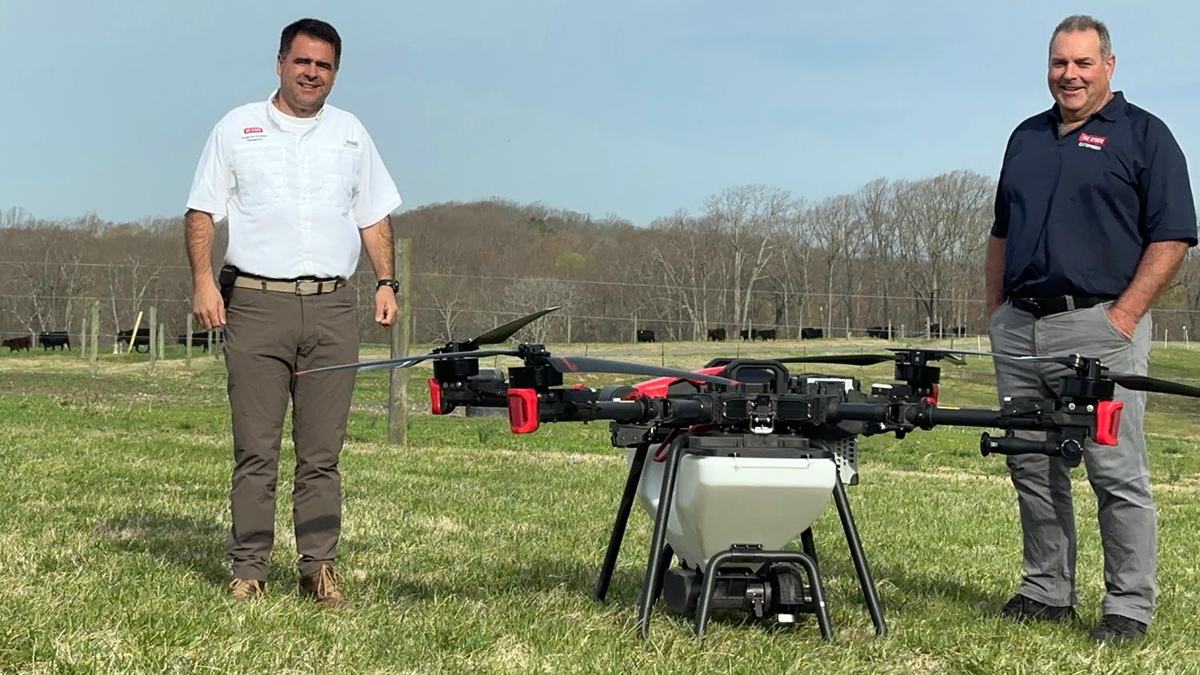
Miguel Castillo and Seth Nagy with a drone used to frost seed clover in fescue fields after Hurricane Helene.
Embracing Drone Technology
Nagy brought his hobbyist enthusiasm to flying drones, but this is not just a cool hobby. It is serious tech, with a serious purpose.
He has used drones for aerial photography and mapping for research projects; spraying fields and orchards, including hard-to-access areas; seeding cover crops and other materials; and monitoring and inspecting crops and tree plantings.
“There are scenarios where the drones really shine,” Nagy said. “Just like anything else, there's a specific thing in mind that you should be doing with it, that guides what hardware, software and support equipment you need. If you went to the tractor store and said, ‘Okay, I want to do agriculture,’ that doesn't work. Drones are the same way.”
One of Nagy’s first uses of a drone was to combat an encroaching fire ant issue. The dangerous, invasive pests had been spotted in a neighboring county. He decided to begin with aerial reconnaissance.
“I thought, ‘Let's see if we could identify these things using a camera drone, and then we'd know where to direct control measures,’” he said.
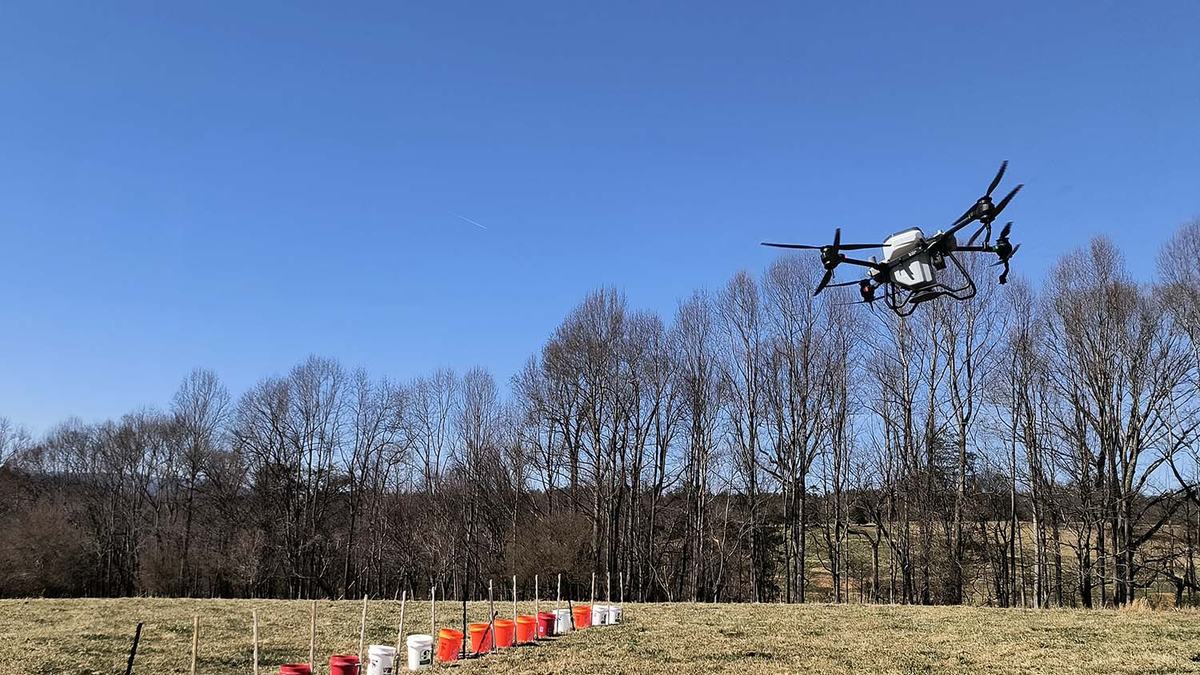
A DJI T40 agricultural drone flys a course that will determine the swath width, allowing seed to be spread evenly over the field.
He and Jason Ward, a campus-based Extension specialist in precision agriculture, did some mapping flights on a 200-acre farm in Rutherford County to test the technology. They identified ant mounds and used GPS technology to make it easy to find them again.
At first, they thought that a tractor equipped with GPS guidance would be the tool to apply insecticide. Then Ward had another idea. If the drone could find them, why not equip it to treat them?
“Jason said we could do a ground-based application, but it'd be really neat if we could fly over with a drone and put fire ant bait out,” Nagy said.
A large eight-rotor drone had been donated to the department of Biology and Agricultural Engineering. Ever the tinkerer, Nagy equipped it with an open source flight controller and a spreader.
“That was my first spray drone,” he said. “The thing was a hoss, it was huge. It wasn't the spray drones that you fly now. This was just a little bit of a Frankenstein creation, but it was really neat.”
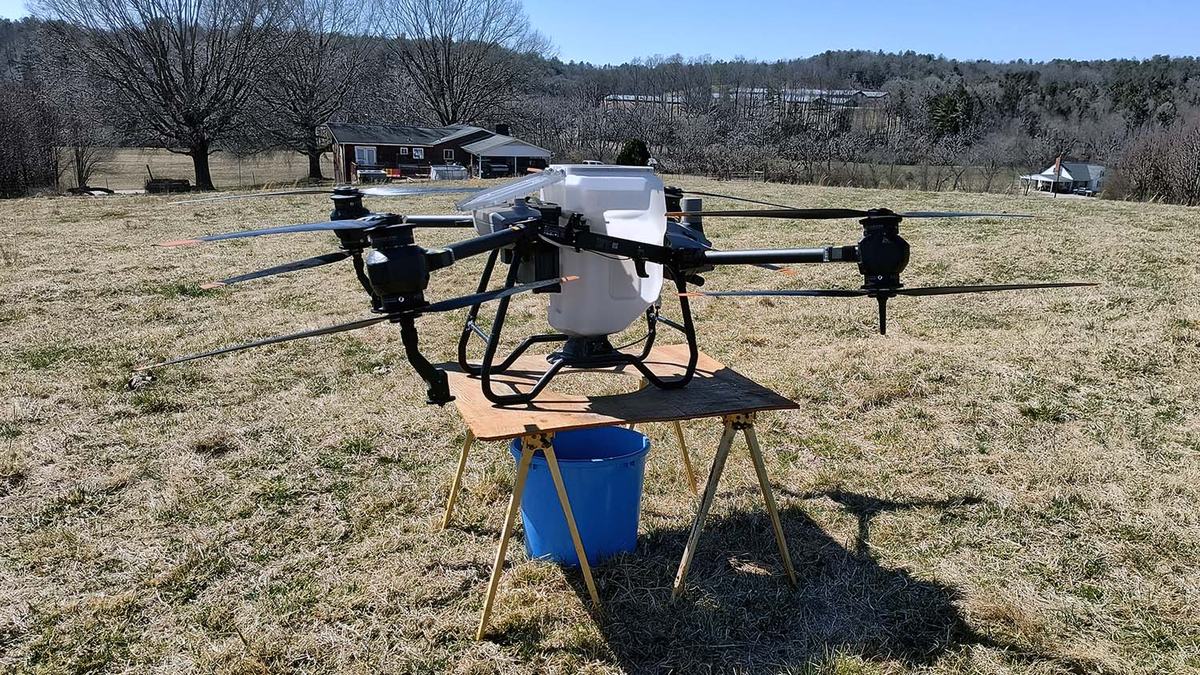
A drone performs a calibration on clover seed. The calibration lets the drone know how much seed is being dispensed as the gate transitions from fully closed to fully open.
Since then, he has used UAVs on many projects, including seeding cover crops intended to choke out herbicide-resistant weeds on Christmas tree farms; helping Extension rumination nutrition specialist Matt Poore and pastureland expert and Amazing Grazing coordinator Johnny Rogers with a bale grazing study in Caldwell County; applying fungicide in tobacco fields; capturing data for a corn variety trial; and uniformly spreading pre-emergent on ornamental plants in container production.
Nagy also was one of the drone operators helping farmers in the aftermath of Hurricane Helene.
One of Castillo’s research projects, funded by USDA-CARE (Critical Agricultural Research and Extension), involves testing options to introduce legumes into existing pastures to improve animal performance and overall pasture health.
Tall fescue is the predominant forage grass in the Piedmont and mountains of North Carolina. It is a disease resistant and grazing-tolerant species. However, many acres of tall fescue have a wild-fungi living within the plant that produces ergot alkaloids.
“When grazing livestock eat those alkaloids, they can develop a condition called fescue toxicosis that results in reduced intake,” Castillo said. “If they eat less than what is needed, they perform worse. There are associated reproductive issues as well. Dramatic visual symptoms include swollen or sloughing hooves and tails.”
Agricultural drones were used to frost seed clover.
Legumes mitigate fescue toxicosis by providing better nutrition than grasses alone. In addition, legumes enrich the soil through nitrogen fixation, reducing input costs by making farmers less reliant on fertilizer. As an added bonus, floral legumes support pollinators.
Castillo’s research includes planting legumes like clovers during winter via a process called frost seeding, which is usually done with a tractor or a utility vehicle mounted with a spreader.
After Hurricane Helene hit western North Carolina in late September 2024, Nagy and Castillo began talking about using UAVs to address a forthcoming critical hay and forage shortage.
“Here was an opportunity to frost-seed during winter into areas that were bare ground, to provide some cover to the soil, jump start the growing season, and introduce legumes into pastures,” Castillo said.
In collaboration with Nagy and Rob Austin, Extension specialist for geographic information systems, Castillo secured a USDA rapid response grant that covered the cost of seed and equipment. Nagy, David Davis and other Extension operators did some of the flying, using drones capable of carrying up to 120 pounds of seed. Experienced and licensed agricultural drone pilots were contracted in other areas.
As the work progressed Castillo became even more convinced of the benefits of drones in certain situations. They can get to places tractors can’t easily reach, allowing timely intervention, and operate in conditions when traditional farm machinery can’t go.
“We have a responsibility to make sure that our recommendations are backed by research, and that they actually work,” Castillo said. “That's how we embrace drones. Drones, coupled with grazing livestock, provide a recipe to improve timely planting and to ensure soil-seed contact, improving the success of frost-seeding.”
The Right Tool for the Right Job
Drones were ideal for seeding fields after Hurricane Helene. They can be effective for weed and pest management, and for procuring data on crop health.
But not even the most enthusiastic UAV proponent expects them to replace traditional farm equipment. The quintessential sight of a tractor in a field won’t be replaced by a drone buzzing above.
David Davis, director of Extension's Yancey County Center, uses a controller to map the flight plan for his agricultural drone.
There are barriers to widespread adoption. An agricultural drone capable of carrying 120 pounds of seed costs upwards of $40,000 and typically is limited to about six or seven minutes of flight time on a battery charge when fully loaded.
Licensing requirements can be complicated. A commercial operator must pass an FAA-administered knowledge test and a TSA background check. A remote pilot certificate is required to fly an agricultural spray drone. Additional waivers and certifications are needed to fly a drone that weighs more than 55 pounds.
“There's some significant challenges to flying the bigger drones legally,” Nagy said.
There is also a learning curve. It can look easy on a demonstration day when someone like Nagy hits a button on a controller that sends a drone along a pre-programmed flight path, but it’s not that simple.
“It looks like I show up and then the drone flies,” Nagy said. “There was programming before the flight. I map the field, create the boundary, and note if there's any obstacles. I do all that work on the computer.”
But drones do have a place in the future of agriculture. Extension experts such as Nagy, Castillo, Austin, Ward and Kenny Bailey, Extension’s agriculture agent in Cumberland County and a licensed spray drone operator, are proving that.
Extension UAV operators will continue to use them in research projects and for mapping, spraying and seeding. They will continue to demonstrate them to producers interested in how technological advances can help on the farm.
In some cases, producers who understand that drone seeding can improve the nutrition and productivity of livestock in smaller operations or in pastures where tractors can’t go might choose to hire professional operators.
“Many farmers who were reluctant to use technology may see an applicable use of drones for pasture work,” Castillo said. “They don’t have to buy a drone, but can hire a good pilot with a drone”
Even in those scenarios, Extension has an important role to play.
“They still are going to need a good agronomist to work with them, which will most likely be their Extension person,” Castillo said. “The pilot will need to be provided with a mission that includes details of what product to spray, what seed to spread, and when to do it. The pilots may know nothing about fescue toxicosis or nitrogen fixation, but if Extension gives them a mission that integrates knowledge of a proven agronomic practice, I think that's the recipe.”
Whatever the situation, it’s certain that Nagy will continue to be involved. His one-time hobby has become an important part of his Extension work.
“It's almost like I've been here all along,” he said. “I've been dabbling with these different hobbies and these different things my whole career.
“This is what we do at Extension. We learn something, we try something, we use it to help the community, and then we try to improve on it.”