Planting
and Harvesting Guide
for Piedmont Vegetables and Herbs
Created
by
Doug Jones,
Land Lab Manager, CCCC Sustainable Farming Program
and
Debbie Roos,
Agriculture Extension Agent, North Carolina Cooperative Extension, Chatham County
Center
Read
First: How to Use this Guide
Click
Here to Download a Printable Version
| |
Planting
date if using season extension |
|
|
|
Planting
date if not using season extension |
| |
|
|
|
|
|
|
|
|
|
|
|
|
|
|
|
|
|
| |
Harvesting
date if using season extension |
|
|
|
|
Harvesting
date if not using season extension |
| |
|
|
|
|
|
|
|
|
|
|
|
|
|
|
|
|
|
| SE |
=
Season Extension |
|
|
|
|
|
DS |
=
Direct Seed |
|
|
|
|
| H |
=
Harvest |
|
|
|
|
|
TP |
=
Transplant |
|
|
|
|
OW |
=
Overwinter |
|
|
|
|
|
OS |
=
Oversummer |
|
|
|
|
| |
Jan |
Feb |
Mar |
Apr |
May |
Jun |
Jul |
Aug |
Sep |
Oct |
Nov |
Dec |
| |
| |
|
SE |
DS |
|
SE |
DS |
|
OW |
|
OW |
Overwinter
Harvest |
H |
SE |
|
H |
SE |
OW |
| |
|
|
|
SE |
TP |
|
SE |
TP |
|
| |
H |
SE |
|
H |
SE |
|
| |
|
|
|
DS |
|
DS |
|
| |
H |
|
H |
SE |
| |
|
| |
|
SE |
DS |
|
SE |
DS |
OW |
|
OW |
Overwinter
Harvest |
H |
|
H |
SE |
|
|
| |
Jan |
Feb |
Mar |
Apr |
May |
Jun |
Jul |
Aug |
Sep |
Oct |
Nov |
Dec |
| |
|
|
|
DS
or TP |
|
DS
or TP |
|
Overwinter
Harvest |
H |
|
H |
SE |
| |
|
|
|
DS |
|
DS |
|
Overwinter
Harvest |
H |
|
H |
SE |
|
|
|
|
TP
Senposai |
|
DS
or TP |
|
Overwinter
Harvest |
H |
|
Senposai |
H |
| |
|
|
|
TP |
|
TP |
|
| |
H |
|
H |
SE |
|
| |
|
| |
Jan |
Feb |
Mar |
Apr |
May |
Jun |
Jul |
Aug |
Sep |
Oct |
Nov |
Dec |
| |
|
|
|
TP |
|
TP |
|
Overwinter
Harvest |
|
H |
|
H |
SE |
| |
|
|
|
SE |
TP |
|
TP |
|
| |
H |
|
H |
SE |
|
| |
|
|
|
SE |
TP |
|
SE |
H |
|
H |
SE |
| |
|
| |
|
SE |
TP |
|
TP |
|
| |
H |
|
H |
|
| |
|
| |
Jan |
Feb |
Mar |
Apr |
May |
Jun |
Jul |
Aug |
Sep |
Oct |
Nov |
Dec |
| |
|
|
|
SE |
TP |
|
| |
H
green |
H
mature |
|
| |
|
|
|
DS
or TP |
TP |
|
Overwinter
Harvest |
H |
|
H |
SE |
| |
|
|
|
DS |
|
DS |
|
| Overwinter
Harvest |
|
H |
SE |
| |
|
|
|
DS |
|
SE |
DS |
OW |
|
| |
Overwinter
Harvest |
|
H |
|
H |
SE |
| |
|
| |
Jan |
Feb |
Mar |
Apr |
May |
Jun |
Jul |
Aug |
Sep |
Oct |
Nov |
Dec |
| |
|
|
|
SE |
DS |
|
SE |
DS |
OW |
|
OW |
OW
Harvest |
H |
|
H |
SE |
OW |
| |
|
|
|
DS
Dwarfs |
|
| |
DS
Trellis
|
|
| |
H
Dwarfs |
|
|
| |
H
Trellis |
| |
|
|
|
DS |
|
SE |
DS |
OW |
|
| Overwinter
Harvest |
H |
|
H |
SE |
| |
|
|
|
SE |
DS |
|
DS |
|
| |
H |
Umbels |
|
H |
SE |
|
| |
|
| |
Jan |
Feb |
Mar |
Apr |
May |
Jun |
Jul |
Aug |
Sep |
Oct |
Nov |
Dec |
| |
|
|
|
DS
or TP |
|
DS
or TP |
|
OW
Harvest |
|
H |
|
OS
Harvest |
H |
SE |
| |
|
|
|
DS |
|
| |
H |
|
| |
|
|
|
DS |
|
| |
H |
|
| |
|
|
|
SE |
DS
or TP |
|
DS
or TP |
|
OW |
OW
Harvest |
H |
|
H |
SE |
OW |
| |
|
| |
Jan |
Feb |
Mar |
Apr |
May |
Jun |
Jul |
Aug |
Sep |
Oct |
Nov |
Dec |
| |
|
|
|
DS |
|
DS |
|
| |
H |
|
H |
|
| |
|
|
|
DS
or TP |
|
| |
H |
SE |
|
| |
|
|
|
SE |
TP |
|
| |
H |
SE |
|
| |
|
|
|
SE |
TP |
|
| |
H |
SE |
|
| |
|
| |
Jan |
Feb |
Mar |
Apr |
May |
Jun |
Jul |
Aug |
Sep |
Oct |
Nov |
Dec |
| |
|
|
|
SE |
TP |
|
| |
H |
SE |
|
| |
|
|
|
SE |
DS |
|
| |
H |
SE |
|
| |
|
|
|
DS |
|
| |
H |
|
| |
|
|
|
DS
or TP |
|
| |
H |
|
| |
|
| |
Jan |
Feb |
Mar |
Apr |
May |
Jun |
Jul |
Aug |
Sep |
Oct |
Nov |
Dec |
| |
|
|
|
DS
or TP |
|
| |
H |
|
| |
|
|
|
DS
or TP |
|
| |
H |
|
| |
|
|
|
DS
or TP |
|
| |
H |
|
| |
|
| |
Jan |
Feb |
Mar |
Apr |
May |
Jun |
Jul |
Aug |
Sep |
Oct |
Nov |
Dec |
| |
|
|
|
DS
or TP |
|
| |
H |
|
| |
|
|
|
TP |
|
| |
H |
|
| |
|
|
|
DS
or TP |
|
| |
H |
|
| |
|
| CROP |
Jan |
Feb |
Mar |
Apr |
May |
Jun |
Jul |
Aug |
Sep |
Oct |
Nov |
Dec |
| |
|
|
|
|
|
|
|
|
|
|
|
|
|
|
|
|
|
|
|
|
|
|
|
|
How
to Use this Guide
This is a planting and harvesting
guide, not a schedule. Please use these dates as a starting point and
adjust according to the conditions on your farm. These dates are not set in
stone! Weather and crop conditions vary from year-to-year, and from farm-to-farm.
Doug Jones, the farm manager for
Central
Carolina Community College's Sustainable Farming Program in Pittsboro,
developed on paper a planting and harvesting guide for his favorite vegetable
crops, based on his experiences at the Land Lab. The Land Lab is CCCC's five-acre
outdoor classroom for research, demonstration, and crop production and is located
about 1 mile west of downtown Pittsboro in Chatham County. Debbie recognized
Doug's guide as a valuable tool and spent many hours working with him to flesh
it out, adding additional crops and also planting and harvesting dates for growers
using season extension techniques. Debbie then adapted and formatted the guide
to make it easy to read (hopefully!) on the web. Our hope is that local growers
will use this guide to try new crops and extend their season so we can produce
for our expanding local markets like Chatham
Marketplace and our farmers'
markets.
The key at the top of the chart explains
the colors and abbreviations. You can click on the crop name for more notes
and a text description of planting and harvesting dates. Season extension techniques
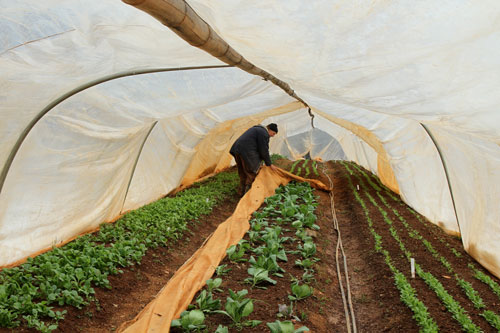
can be used to protect from both cold and heat and include row covers, high
tunnels, shade, micro-sprinklers, etc. See below for more information on season
extension techniques.
The planting windows and harvest
times assume succession plantings - every 1-2 weeks.
For More Information:
Learn
all about season extension - North Carolina Cooperative Extension,
Chatham County Center
Resources
and Suppliers for Season Extension - North Carolina Cooperative Extension,
Chatham County Center
Consult the Vegetable
Variety List for information on recommended varieties.
For more information on crop production,
seed sourcing, pest management, marketing, local farms, and much more, visit
Chatham County Cooperative Extension's Growing
Small Farms website!
We would really like your feedback
on this guide. We plan to continue fine-tuning and expanding it. Please email
Debbie Roos with any comments, questions,
or suggestions.
Crop
Notes
Salad
Mix
- Mild Salad Mix – lettuces,
baby kale, baby chard, baby mild mustard
- Spicy Salad Mix – arugula,
cress, spicy mustards
- Direct-seed February 1-March 15
if using season extension techniques, for harvest April 1-June 15 (up until
mid-July if season extension techniques such as micro-sprinklers and shade
are employed). If not using season extension, plant March 15-May 1. If not
using shade cloth, harvest ends around mid-June.
- Direct-seed August 1-October 1
for harvesting September-December. Must use season extension (shade cloth,
heat-tolerant varieties, micro-sprinklers) if planting in August. If not using
season extension to manage heat, start harvesting in mid-October. Harvest
of spicy salad mix ends sooner due to pest pressure unless you use a row cover.
- Extend season of fall planting
by using row covers Dec 1-15.
- Direct-seed mix for overwintering
in early November and protect with row covers or tunnels or both. Harvest
begins Feb. 1 with overwintered salad mix.
Back
to Guide
Lettuce
(head)
- Transplant February 15-March 15
if using season extension for harvest beginning April 1.
- Transplant March 15-April 15 if
not using season extension.
- Harvest period for spring plantings
runs April 1-June 1 if using season extension as weather warms. Lettuce harvested
after June 1 will be bitter; use shade May 15-June 1.
- For fall lettuce, transplant August
15-September 15 if using season extension; otherwise plant September 15-October
15.
- Harvest September 15-December
15 and use row covers after November 15 (lettuce is semi-hardy).
Back
to Guide
Arugula
- Direct-seed February 15-April
1 for harvesting April 1-June 1.
- Direct-seed August 1-October 1
for harvesting September 15-January 1 (use season extension after December
15).
Back
to Guide
Spinach
- Direct-seed February 1-April 1
(use season extension techniques for February plantings) for harvesting April
1-May 15.
- Direct-seed August 15-October
15 for harvesting October 1-December 1 (use season extension like micro-sprinklers
for earliest fall plantings).
- Direct-seed spinach for overwintering
October 15-November 15 and protect with row covers or tunnels or both. Harvest
begins Feb. 1 with overwintered spinach.
Back
to Guide
Kale
- Direct-seed or transplant February
15-March 15 for harvesting April 1-May 1.
- Direct-seed or transplant August
1-October 1 for harvesting October 1 and on through the winter (with season
extension) until April.
Back
to Guide
Mustard
- Direct-seed or transplant February
15-March 15 for harvesting April 1-May 1.
- Direct-seed or transplant August
1-October 1 for harvesting September 1 and continuing through the winter (with
season extension after December 15) until April.
Back
to Guide
Collards
- We recommend growers try an Asian
version of collards called Senposai - it's faster growing, much more tender,
equally winter hardy and also heat tolerant. Seed is available from Fedco
or Doug Jones.
- Transplant Senposai February 15-March
15 for harvesting April 1-May 15.
- Direct-seed or transplant August
15-September 15 for harvest starting mid-November on through the winter (with
season extension). Harvest of Senposai starts earlier, in early October.
Back
to Guide
Broccoli
- Transplant February 15-March 15
for harvesting April 15-June 1.
- Transplant
August 15-September 15 for harvest October 15-December 15 (use season extension
after December 1).
- If plants are well-hardened, may
not need row covers in spring; best to use mid-maturing (not earliest, not
latest) varieties in both the spring and fall planting windows so
crop will mature in time.
- Note: cauliflower
is a difficult crop for the Piedmont so is not included here. It has a narrower
range of heat and cold tolerance than broccoli so it is less reliable. The
developing head is not adapted to our extreme temperature fluctuations and
the head quality becomes really poor as it warms up.
Back
to Guide
Cabbage
- Transplant February 15-April 1
for harvesting May 1-June 15.
- Transplant
August 15-September 15 for harvest starting October 15 and on through the
winter (use season extension after December 15) up until mid-March.
- If plants are well-hardened, may
not need row covers in spring; best to use mid-maturing (not earliest, not
latest) varieties in both the spring and fall planting windows so
crop will mature in time.
Back
to Guide
Pac
Choi
- Also called Bok Choy or Pak Choi
- Transplant March 1-April 1 for
early March plantings) for harvesting April 15-May 15.
- Transplant August 15--October
1 for harvesting October 1-December 15 (use season extension after November
15).
Back
to Guide
Brussels
Sprouts
- Transplant July 15-September 1
(use season extension techniques for cooling July 15-August 15).
- If planted July 15-August 15,
harvest starts November 15 and continues through the winter (use season extension
December 1-February 1).
- If planted in late August, harvest
begins in February (use season extension December 1-February 1).
Back
to Guide
Green
Onions
- Use onion sets (bulbs).
- Transplant February 1-April 1
for harvesting April 15-June 15 (use season extension for February plantings).
- Transplant August 15-September
15 for harvesting October 1-December 1.
- Onions are hardy but season extension
gives them earliness.
Back
to Guide
Bulb
Onions
- Transplant February 15-April 1
(use season extension for February plantings).
- Harvest fresh onions (green tops)
May 15-June 15; harvest mature onions (dry bulbs) June 15-July 15.
- Onions are hardy but season extension
gives them earliness.
- The earlier you get transplants
into the ground, the bigger the bulb will be. To grow your own seedlings,
direct-seed into flats about two months before planting.
Back
to Guide
Leeks
- Direct-seed or transplant April
1-May 1; transplant May 1-15. Direct-seeding will present more challenges
with weeds.
- Harvest October 1-March 15. Use
season extension Dec. 15-March 1. Use hardy varieties for late harvest, summer
varieties for early harvest.
Back
to Guide
Parsnips
- Direct-seed April 15-May 15 for
harvest starting in early November (100 day crop). One of the riskiest crops
to establish in hot weather - needs 8-10 days to germinate.
- Direct-seed August 15-September
15 for overwintering. For fall planting, use micro-sprinklers to help with
germination.
- Harvest starting November 1 and
going through the winter until mid-March (use season extension after December
15).
- Parsnips do not develop sweet
flavor until the ground is cold so don't rush harvest.
Back
to Guide
Carrots
- Direct-seed February 1-March 15
for harvesting May 1-June 15.
- Direct-seed August 1-October 1
for harvest starting October 15 and continuing through the winter (with season
extension after December 1). For late summer planting, use micro-irrigation
and shade to cool crop. Plantings September 15-October 1 will be for overwintering.
- If using season extension, harvest
January 15-April 1 (certain varieties bolt earlier than others). Carrot greens
are very cold hardy but carrot shoulders will rot if the ground freezes. If
you have a good canopy of carrot greens, it will help protect the shoulders;
can use heavy row covers or a double layer of lighter weight row cover.
Back
to Guide
Beets
- Direct-seed February 1-April 15
for harvesting April 1-June 15. Harvest small beets April 1 and full-sized
beets April 15. The February plantings will require protection with season
extension.
- Direct-seed August 1-October 1
for harvest starting October 1-December 15 (with season extension after November
15). For late summer planting, use micro-irrigation and shade to cool crop.
Plantings September 15-October 1 will be for overwintering.
- If using season extension, harvest
overwintered crop March 1-April 1.
Back
to Guide
Peas
- Direct-seed
dwarf varieties like 'Sugar Anne' February 1-April 1 and harvest April 15-June
1.
- Plant trellised varieties like
sugar snaps February 15-March 15 for harvest May 15-June 15.
- Peas can be tricky to germinate.
Your best bet is to prepare your bed for planting in January and pay attention
to the weather forecast. If it calls for 5 or more days with highs around
65° F, then go ahead and plant your peas no matter when it is. You just
need to get them to germinate - once they are up and growing, they are quite
hardy, even without season extension. If you haven't found a window by late
February, go ahead and plant them and cover with clear plastic right on top
of the bed. Once they germinate, remove the plastic and use a row cover.
Back
to Guide
Cilantro
- Direct-seed February 1-April 1
for harvesting April 1-June 1.
- Direct-seed August 15-October
15 for harvest starting October 1and continuing through the winter (with season
extension after December 15). For late summer planting, use micro-irrigation
to cool crop. Plantings October 1-15 will be for overwintering.
- If using season extension, harvest
overwintered crop up until April 1.
Back
to Guide
Dill
- Direct-seed February 15-April
1 for harvesting April 15-June 1. Harvest umbels (flower heads) for pickling
in June. Use season extension to protect plantings February 15-March 15.
- Direct-seed August 1-September
15 for harvesting September 15-December 15 (with season extension after November
15).
Back
to Guide
Parsley
- Direct-seed or transplant February
15-March 15 for harvesting April 15-July 1. Use season extension to protect
plantings February 15-March 15.
- You can get a good harvest in
the fall by bringing the spring-planted parsley through the summer; it's a
biennial so it's not going to bolt. Parsley is not harvestable in the summer
but it will survive and pick back up in the cool weather and can be harvested
again in October.
- Direct-seed or transplant September
1-15 for harvest starting November 15 and continuing through the winter (with
season extension after December 15) through to early April.
Back
to Guide
Garlic
- Plant
October 15-December 1 for harvesting May 15-July 1.
- The first two
weeks of harvest are in the green stage (customers love green garlic!).
- Even though the harvest period
is six weeks long, garlic stores very well so you can market them for six
months. In general, soft-neck garlic stores better than hard-neck garlic.
Back
to Guide
Potatoes
- Plant potatoes March 15-April
1 for harvesting June 1-July 15.
Back
to Guide
Chard
- Direct-seed or transplant February
15-April 1 for harvesting April 15-July 1. Use season extension to protect
plantings February 15-March 15.
- Direct-seed or transplant August
15-September 15 for harvest October 1-December 15 (use season extension after
November 15).
- Protect the crop through the winter
and harvest again starting March 1 (overwintered harvest will overlap with
harvest from spring plantings).
Back
to Guide
Radish
- Direct-seed February 15-April
1 for harvesting April 1-May 15.
- Direct-seed or transplant September
1-October 15 for harvest October 1-December 1.
Back
to Guide
Basil
- Direct-seed or transplant May
1-August 1 for harvesting June 15-November 1 (use season extension after October
15).
- Tthe earliest harvest presumes
a transplanted crop.
Back
to Guide
Tomatoes
- Transplant
April 1-June 15 (use season extension for first half of April until weather
warms) for harvesting May 15-November 1 (use season extension after October
15).
- Expect yield to decline towards
the end of summer.
Back
to Guide
Peppers
- Transplant April 15-June 15 (use
season extension for second half of April until weather warms) for harvesting
July 1-November 15 (use season extension after October 15).
- It possible to
plant up until June 15 and still get a good crop but yields will generally
be greater from earlier plantings.
Back
to Guide
Eggplant
- Transplant April 15-June 15 (use
season extension for second half of April until weather warms) for harvesting
July 15-November 1 (use season extension after October 15).
- Later plantings can provide insurance
for summer flea beetle problems; need to use row covers on eggplant for first
six weeks after planting for protection against flea beetles and potato beetles.
Back
to Guide
Snap
Beans
- Direct-seed April 1-August 15
(use season extension for month of April until weather warms) for harvesting
June 1-November 1 (use season extension after October 15).
- The soil
needs to be warm for germination. For plantings in April, plant under clear
plastic and remove after the beans germinate.
Back
to Guide
Lambsquarters
- Direct-seed May 1-July 15 for
harvesting June 1-September 15.
- This is one of the few greens
that tastes delicious and produces through the summer with minimal insect
problems. A great summer green!
- Seed available from Seeds
of Change, Sow
Organic Seed Co.
Back
to Guide
Cucumbers
- Direct-seed or transplant May
1-August 1 for harvesting June 15-October 15.
- For both cucumbers and summer
squash, the most reliable crops are the early ones. Typically productivity
declines rapidly after mid-summer. Early plantings produce for about one month;
later plantings for shorter periods.
Back
to Guide
Summer Squash
- Direct-seed or transplant May
1-August 1 for harvesting June 15-October 15.
- For both cucumbers and summer
squash, the most reliable crops are the early ones. Typically productivity
declines rapidly after mid-summer.
Back
to Guide
Cantaloupe
- Direct-seed or transplant May
1-July 1 for harvesting July 1-October 15.
Back
to Guide
Watermelon
- Direct-seed or transplant May
1-July 1 for harvesting July 1-October 15.
- Watermelons tend to be more tolerant
of diseases than cantaloupes on average; therefore, watermelons are usually
more reliable for a late summer crop.
- Watermelons usually store very
well, as long as a month if kept cool.
Back
to Guide
Winter
Squash
- Direct-seed or transplant May
1-July 15 for harvesting July 1-October 15.
- The species moschata
(butternut) is the most reliable due to vine borer resistance.
Back
to Guide
Sweetpotato
- Transplant
May 15-July 1 for harvesting September 15-November 1.
- Even though the harvest period
is six weeks long, sweetpotatoes store very well so you can market them for
six months total. You need to cure sweetpotatoes at relatively warm temperatures
for a couple of weeks after harvest (can place in a greenhouse).
Back
to Guide
Okra
- Direct-seed or transplant May
1-June 1 for harvesting August 1-November 1.
Back
to Guide

Chatham Cou
Website
created and maintained by Debbie
Roos,
Agricultural Extension Agent.
Last
updated October 15, 2007.
Visit
Debbie's Growing Small Farms Website!
Chatham
County Center, North Carolina Cooperative Extension
PO Box 279, Pittsboro, NC 27312
919-542-8202
URL:
www.ces.ncsu.edu/chatham/ag/SustAg/index.html
North
Carolina Cooperative Extension is an educational partnership helping people
put research-based knowledge
to work for economic prosperity, environmental stewardship, and an improved
quality of life.
Return
to Growing Small Farms Home
©2006
North Carolina Cooperative Extension