
Basil Problem
go.ncsu.edu/readext?175285
en Español / em Português
El inglés es el idioma de control de esta página. En la medida en que haya algún conflicto entre la traducción al inglés y la traducción, el inglés prevalece.
Al hacer clic en el enlace de traducción se activa un servicio de traducción gratuito para convertir la página al español. Al igual que con cualquier traducción por Internet, la conversión no es sensible al contexto y puede que no traduzca el texto en su significado original. NC State Extension no garantiza la exactitud del texto traducido. Por favor, tenga en cuenta que algunas aplicaciones y/o servicios pueden no funcionar como se espera cuando se traducen.
Português
Inglês é o idioma de controle desta página. Na medida que haja algum conflito entre o texto original em Inglês e a tradução, o Inglês prevalece.
Ao clicar no link de tradução, um serviço gratuito de tradução será ativado para converter a página para o Português. Como em qualquer tradução pela internet, a conversão não é sensivel ao contexto e pode não ocorrer a tradução para o significado orginal. O serviço de Extensão da Carolina do Norte (NC State Extension) não garante a exatidão do texto traduzido. Por favor, observe que algumas funções ou serviços podem não funcionar como esperado após a tradução.
English
English is the controlling language of this page. To the extent there is any conflict between the English text and the translation, English controls.
Clicking on the translation link activates a free translation service to convert the page to Spanish. As with any Internet translation, the conversion is not context-sensitive and may not translate the text to its original meaning. NC State Extension does not guarantee the accuracy of the translated text. Please note that some applications and/or services may not function as expected when translated.
Collapse ▲|
Photos by Debbie Roos, Agricultural Extension Agent.
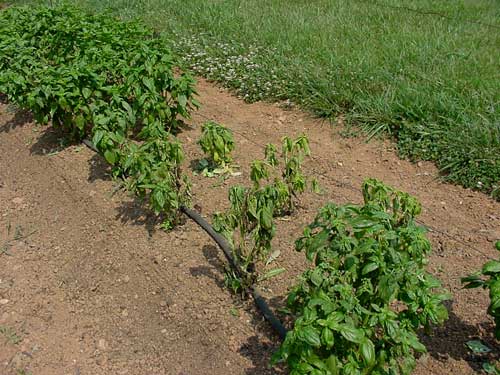
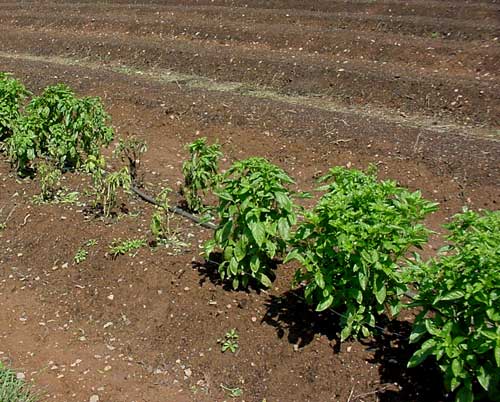
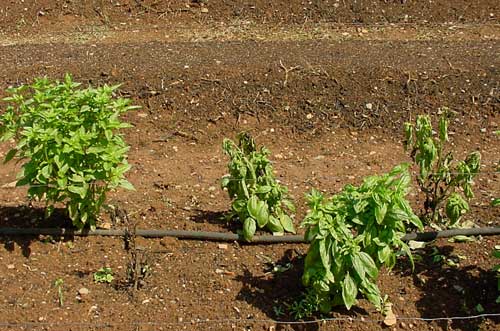
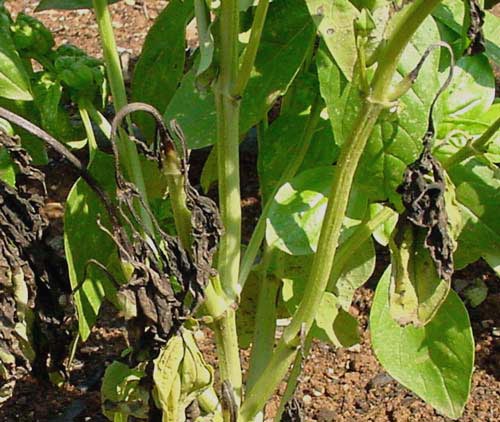
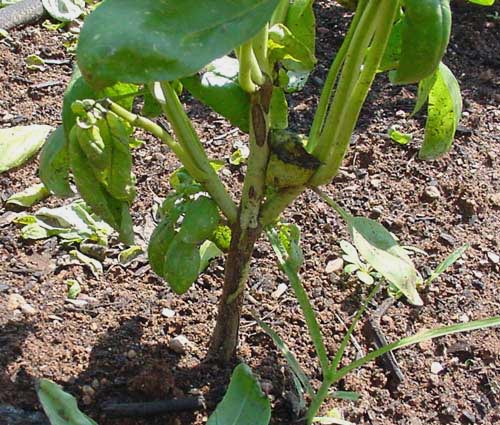
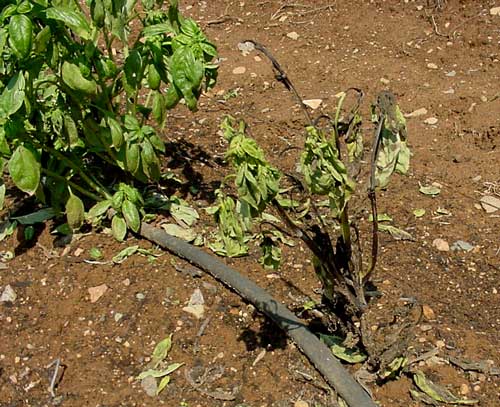
July 2005Fusarium WiltThis basil is suffering from Fusarium wilt, a devastating disease caused by a soilborne pathogenic fungus. According to NCSU’s Basil Horticultural Informational Leaflet, Fusarium oxysporum f. sp. basilicum was first discovered in the U.S. in 1991 and identified in N.C. in 1992. Plants infected with this disease usually grow normally until they are six to twelve inches tall, then they become stunted and suddenly wilt. Initial symptoms usually include brown streaks on the stems, discoloration of the internal stem tissue, a shepherd’s crook appearance of stems, and sudden leaf drop (see photos below for examples of all these symptoms). Interestingly, only sweet basil is affected. Some of the specialty basils, such as lemon basil and purple basil, show some resistance to the disease. The disease is introduced into fields, hydroponic systems, and greenhouse culture primarily through contaminated seed. Growers should only buy basil seed that has been tested for the fusarium wilt fungus. Currently, these tests involve growing out a large number of seed and looking for disease symptoms. This does not guarantee that the seed will be free of infection, but it greatly reduces the risk. If it is not possible to obtain tested seed, the seed should be soaked in cold water for four hours followed by a heat treatment of 20 minutes in 133-136° F water. Seed germination rates will probably be reduced by the hot water treatment, so a germination test should be conducted on a small lot of the treated seed to determine how much seeding rates need to be adjusted. Also, the hot water treatment causes a sticky layer to develop on the outer surface of seed making it difficult to handle. Some seed companies also sell resistant varieties. Once a field has become infested with the fusarium wilt pathogen, infective propagules may persist in the soil for 8-12 years. During that time, growers should avoid growing sweet basil or members of the mint family. Mints will not exhibit symptoms of the disease but may carry over the inoculum from year to year. There are currently no products registered to help control this disease.
This page last updated January 15, 2010. |