[View the original post by D'Lyn Ford at CALS News.]
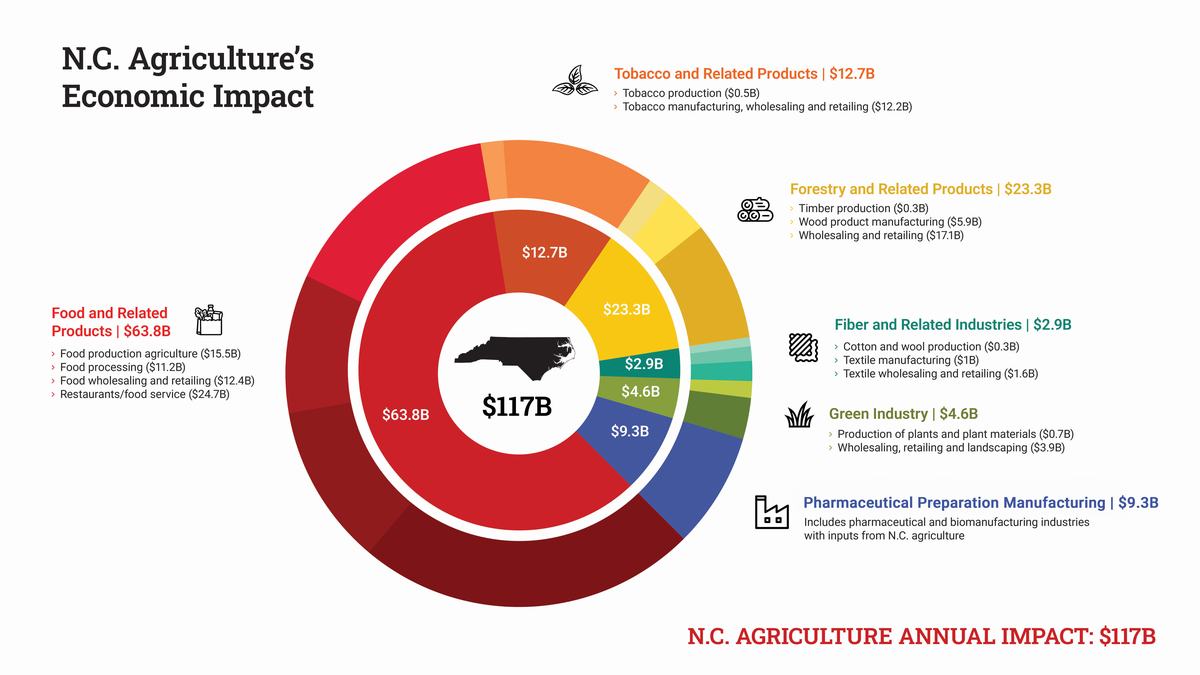
The latest statewide report on the economic impact of agriculture in North Carolina found that the food, fiber and forestry sector employed 20% of North Carolinians and generated $117 billion in economic impact in 2024.
To understand where those statistics come from and how they fit into the larger economic picture of the state’s $844 billion economy, we consulted the source: Jeffrey Dorfman, Hugh C. Kiger Distinguished Professor of agriculture and resource economics at NC State University. Dorfman, who authored the report, made the calculations this year, using the latest available data, which is from 2024.
For this report, I am defining agriculture as the food, fiber and forestry sector. The economic impact includes all the stages from growing and raising farm products until we eat, wear or use them. This definition is the one that NC State University’s College of Agriculture and Life Sciences and the North Carolina Department of Agriculture and Consumer Services have used for more than 40 years.
This total includes input suppliers, such as tractor dealers and fertilizer sellers for production agriculture, as well as processing of the commodities produced, including turkey, pickles, cotton fabric, cigarettes, and wood and paper products, among others. That means we are including restaurants and grocery stores, plus the garden sections at your neighborhood nursery or big box store.
If we looked at production agriculture alone, that would eliminate the food processing and restaurant industries that supply many of our meals. But since almost none of us grind our own flour or eat only whole fruit picked from a tree, that doesn’t provide a complete picture of how food moves from the field to our plates.
Do you use multiplier effects to increase the economic impact numbers?
No. The $117 billion isn’t boosted by multiplier effects. You’ve heard examples of multiplier effects, which sound something like this: A farmer spends money at a local movie theater, which creates jobs there and whose employees spend money at the grocery store, and on it goes. The $117 billion is what the food, fiber and forestry sector directly adds to North Carolina’s economy — the value of goods produced by the various parts of the agricultural sector.
Where does agriculture rank in terms of its economic impact for the state when we include food, fiber and forestry?
That is a surprisingly tricky question to answer. It is clear that agriculture, defined as the food, fiber and forestry sector, employs more people than any other industry in North Carolina — one of every five jobs statewide or about 1 million jobs total. The closest industries in employment are professional and business services, education and health care services, and government, each representing about 15% of state jobs.
However, if we rank industries by the dollar value of their output, then the math gets murky. Professional and business services, real estate, manufacturing, and the retail/wholesale industries are each responsible for generating around 13-15% of North Carolina’s gross state product, very similar to the food and fiber sector. But some of that retailing is food retailing and some of the manufacturing is food and beverage manufacturing. It depends on what category they are counted in, and it can be complicated to untangle.
Furthermore, healthcare shows up with a smaller share of the state’s economy in the official government statistics, but we know from separate sources that Americans spend about 17% of our income on healthcare, so the healthcare sector should probably be the top industry in North Carolina. The problem is one of classification, again. Medical device manufacturing and pharmaceutical manufacturing are included in manufacturing. A bunch of medical buildings are included in real estate. A lot of spending on Medicare and Medicaid is hidden in government spending.
So how do we quantify agriculture’s contributions to North Carolina’s economy?
The best answer I can give is that the food and fiber industry in North Carolina is very large, almost surely smaller than the healthcare sector, and roughly tied with professional and business services, manufacturing, and real estate. However, these industries overlap and many products or services could fairly be counted in at least two different industries.
So, is agriculture North Carolina’s No. 1 industry? There is no single right or wrong answer. It’s simpler to say that the food, fiber and forestry industry in North Carolina is very big in terms of dollars and is the largest in terms of jobs. After that, it’s not really worth fighting about the rest.