NC State Extension Master Food Volunteers help Family and Consumer Sciences agents deliver high-quality, evidence-based programs
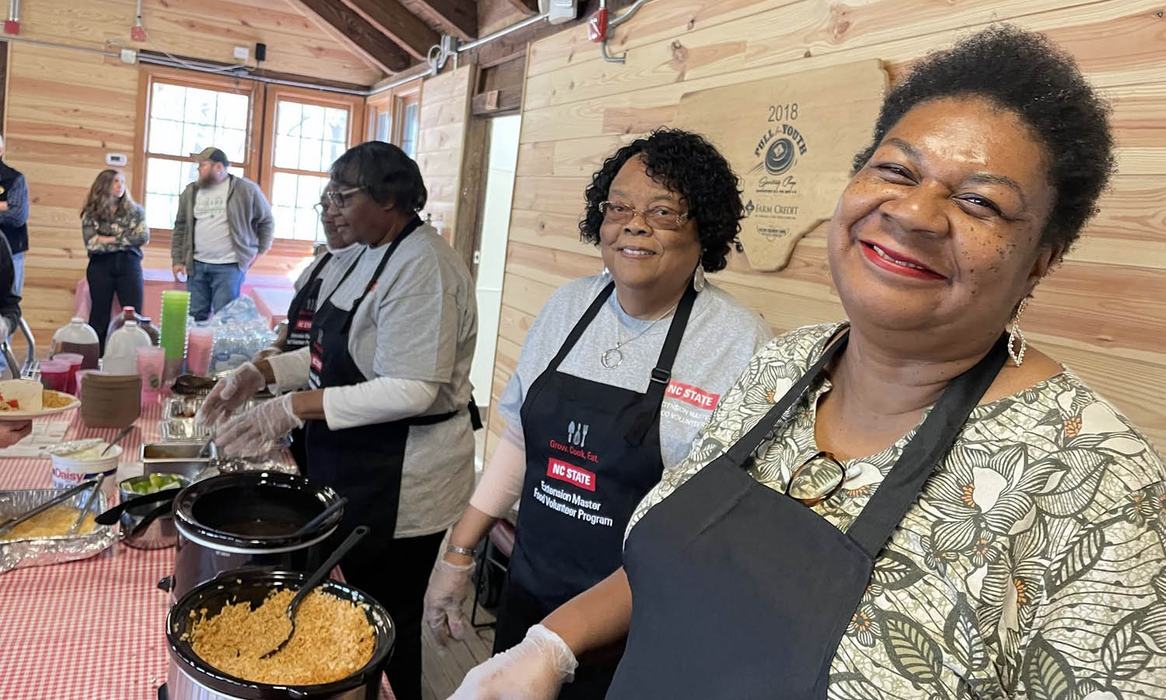
Richmond County FCS agent Cheri Bennett and her volunteers serve food at a community event.
Hayley Cowell travels the length and breadth of Stanly County, teaching her community about nutrition, food safety and healthy living.
The NC State Extension Family and Consumer Sciences agent conducts monthly food and nutrition classes at the downtown library in Albemarle and regularly visits other branches. She goes to senior centers, farmers markets and the hospital. She teaches cooking and fitness classes for adults with autism. She gives lessons on preserving food at the county N.C. Cooperative Extension center.
“Throughout the year, I move around where I can to make sure I'm reaching as many people as possible,” she said.
It’s a lot of work for one person.
“As FCS agents, we wear a lot of hats and we're going in a lot of different directions,” Cowell said. “There's only so much I can do on my own.”
In more than 30 counties, Extension Master Food Volunteers extend the reach of NC State Extension experts by helping deliver high-quality, evidence-based food and nutrition programming in their communities.
“The Master Food Volunteer program is a wonderful, wonderful resource,” Cowell said. “My volunteers help with anything from in-person nutrition and cooking and fitness classes to cooking demonstrations at the farmers markets.”
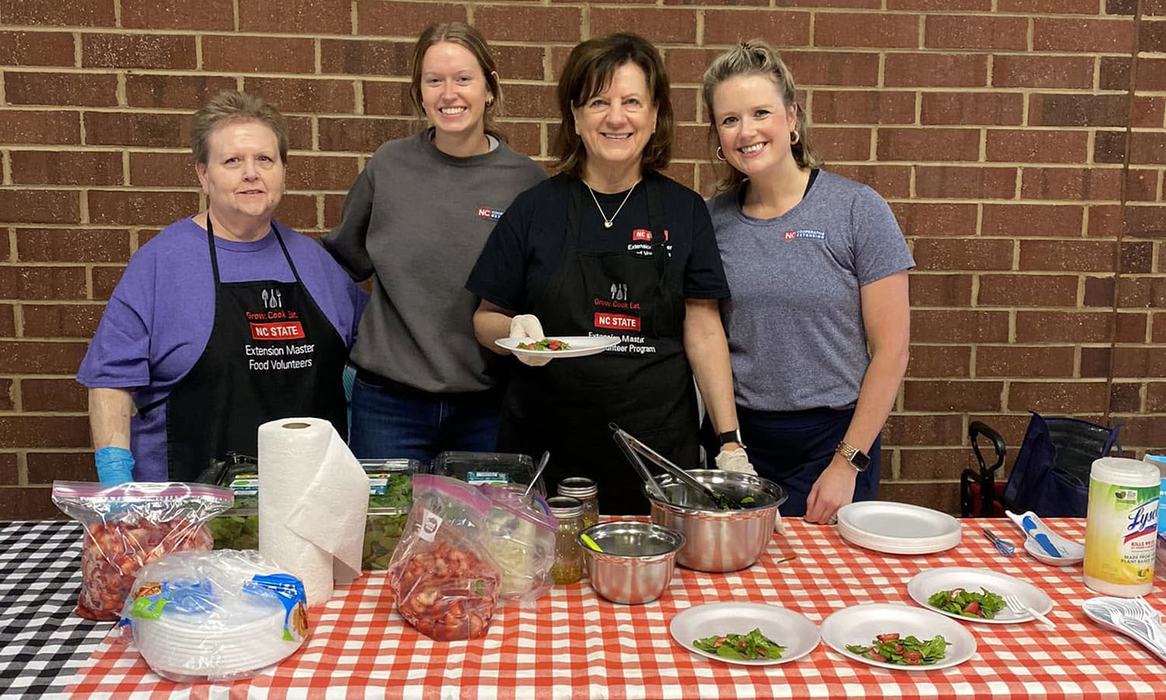
FCS agent Hayley Cowell with two of her Extension Master Food program volunteers in Stanly County
Volunteering to Make a Difference
Across the state, highly trained volunteers assist Extension FCS agents by helping with cooking and food preservation classes. They staff Donation Stations at farmers markets, assemble cook‑along meal kits and co‑host virtual classes.
They also help connect friends and neighbors with Extension programs and trusted health and nutrition information they might not otherwise encounter.
“They are really good at promoting programs in their churches, senior centers, wherever they go,” said Cheri Bennett, FCS agent in Richmond County. “They're really great representatives of the Extension Master Food Volunteer program and Extension.”
The EMFV program traces its roots back to 2014, when a staffing shortage left some counties without FCS programs. A restructuring created several multi-county agents.
“I wanted to offer a full range of programs for all three counties, but it was difficult,” said Marshall, now the EMFV program manager. “As an agent, you have so many tasks. You're planning, marketing, shopping, prepping, teaching the program, evaluating the program, and then reporting on it. There’s only so much you can do.”
Agents needed a way to extend their reach so they could continue to offer health and nutrition information in each county. The solution, in many cases, was in their own N.C. Cooperative Extension centers.
In 80 counties, NC State Extension Master Gardener volunteers meet the needs of the gardening public by providing effective research-based advice and augmenting the efforts of horticulture agents across the state. What if a similar model could be created for FCS agents?
“We thought we could train volunteers and give them the skills and the confidence and the expertise to help with our programs,” Marshall said. “We based it around the Extension Master Gardener volunteers. It is a similar format and I still look to their program and to [EMG program manager] Charlotte Glen for support.”
A team of campus and county Extension professionals led by Extension local foods specialist Dara Bloom worked together to build the program and ensure it worked at the local level.
“Dara was the leading force,” Marshall said. “The way she did it was important to me as an agent. We started out from the very beginning in the same room together deciding what's going to be part of this curriculum, what are the expectations.”
The program trains FCS agents to recruit, train and manage volunteers who can confidently represent Extension in their communities.
Volunteers complete 30 hours of core curriculum training on nutrition, food safety, cooking skills and program management, followed by 30 hours of shadowing an agent. They commit to 20 hours of volunteer service and 10 hours of continuing education annually.
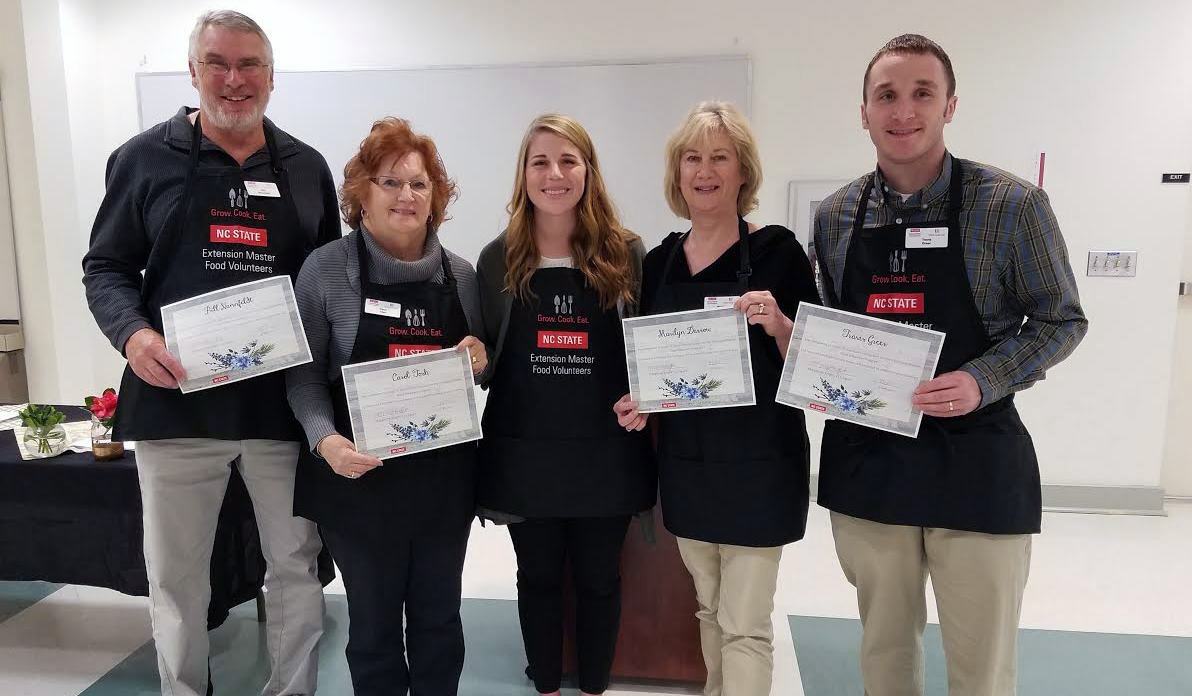
Morgan Marshall (center) with some of the first people trained to serve in the NC State Extension Master Food Volunteers program. Marshall, then the FCS agent in Brunswick County, is now the statewide program manager.
Marshall was an early adopter. After helping build the program, she piloted it in Brunswick County in 2016. She took it to New Hanover and Pender counties the following year, eventually training more than a dozen volunteers.
“We really loved working in food pantries,” Marshall said. “We would do taste tests and cooking demos. We piloted the Donation Station program in New Hanover County on Saturday mornings. Meeting people where they are is really important when it comes to food access.”
Growth came quickly. Since 2017, the EMFV program has trained 90 FCS agents and 298 volunteers, who have collectively reached more than 100,000 community members and contributed 18,435 hours of service, an estimated value of $683,154. There are currently 62 active agents and 169 volunteers.
As program manager, Marshall encourages Extension agents to train their volunteers to go beyond being assistants and to conduct some programs on their own. It’s something she experienced firsthand as a county agent.
“We were asked to do food pantry demonstrations in Brunswick County,” she said. “I had two volunteers who said, ‘You help us shop, pick the recipe, and then we'll go and do the demo.’ That was such a good opportunity for us to be in two places at once.”
Those brief encounters can have an impact well beyond a single demonstration.
“That one interaction could change a behavior for someone,” Marshall said. “It could be their first entrance into Extension. It's the perfect role for volunteers, to give an overview of a topic at a farmers market or at a library or at a church.”
Volunteers in Action
Bennett began the program shortly after becoming the FCS agent in Richmond County five years ago. She relished the idea of recruiting some of the people who regularly came to her events.
“As I learned more about it from other agents and Morgan, I thought it would be a good idea to expose our community members to something larger than just coming to Extension classes,” Bennett said. “They could be a part of something bigger. They could develop skills — leadership skills, cooking skills, food safety and sanitation, public speaking.”
The advantages of having trained and motivated volunteers would be twofold. First, they could assist with the considerable preparation associated with cooking classes, allowing her to concentrate on the lessons.
“In most of my classes, we do some type of food prep,” Bennett said. “It's a lot of work, and then afterwards you have to stay and clean up. I saw that this would be a good way to get some help in the kitchen with the cooking and the food prep.”
They would also allow her to conduct more events throughout the county.
“They could help whenever we go out and do community events,” she said. “We can get so much more done when there's a team. That's why I thought it would be a great idea to bring the Extension Master Food Volunteer program to Richmond.”
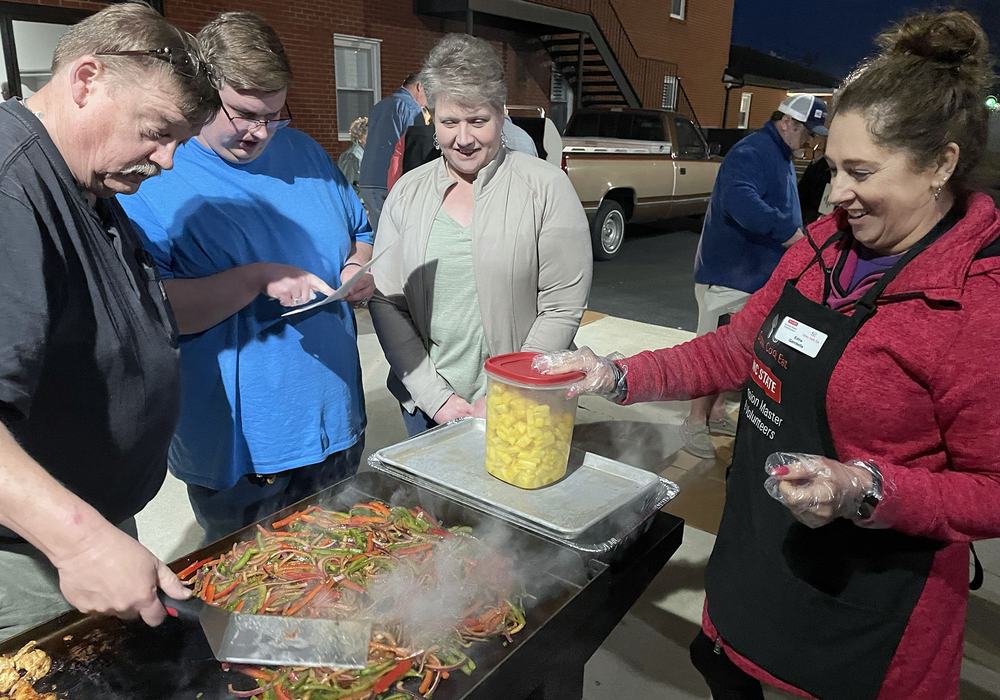
NC State Extension Master Food Volunteers extend the reach of FCS agents when they are able to conduct programs such as cooking demonstrations by themselves
Cowell saw immediate dividends when she launched the program in Stanly County in 2019.
“As agents, we're dealing with calls during the day, helping clients, working on schedules,” she said. “Having someone that's dedicated to prepping the food before going out to a program is heaven-sent. It is so helpful.”
She currently has five trained volunteers, including two who are very highly motivated to help in their community. Their complementary strengths are extremely valuable in implementing her food and nutrition programs.
“Kayla is my behind-the-scenes volunteer,” Cowell said. “She helps me to prep for almost every single program that I do. She just really enjoys it. Pat really enjoys the in-person aspect. She likes to help with handing things out, the food, the handouts, anything I need.”
Cowell’s key volunteers are also sounding boards and sources of ideas, including suggestions of ways they can be further engaged.
“I really like to gather their thoughts and ideas on how things are going, how things can be improved,” Cowell said. “One of my volunteers has recently started spreading her wings and going out and doing her own classes, which really gives her more ownership of this role.”
Whether assisting an FCS agent or leading classes, whether in Stanly or Richmond County, whether in the mountains, on the coast or in the Piedmont, the volunteers tend to have something in common.
“I would say they have the same motivation as I do: community service,” Bennett said. “They love serving. My volunteers are the same way at their church or at the senior center. They're the ones who are in the kitchen or doing the planning for the activities and coming up with ideas.”
Five years after launching it in her county, Bennett remains an enthusiastic supporter of the program.
“The Extension Master Food Volunteers, they're going to be there for you,” she said. “They're going to be the connection that helps an agent get into the community. They're going to be a wide support system for any agent. This is one of the best programs that any county could have. I would recommend every county do it.”
Get Involved
Visit the NC State Extension Master Food Volunteers program page to find out how to get involved